
SynchroMed II Drug Pump
ITB Therapy for Severe Spasticity
Overview
Simple, safe, and effective intrathecal therapy
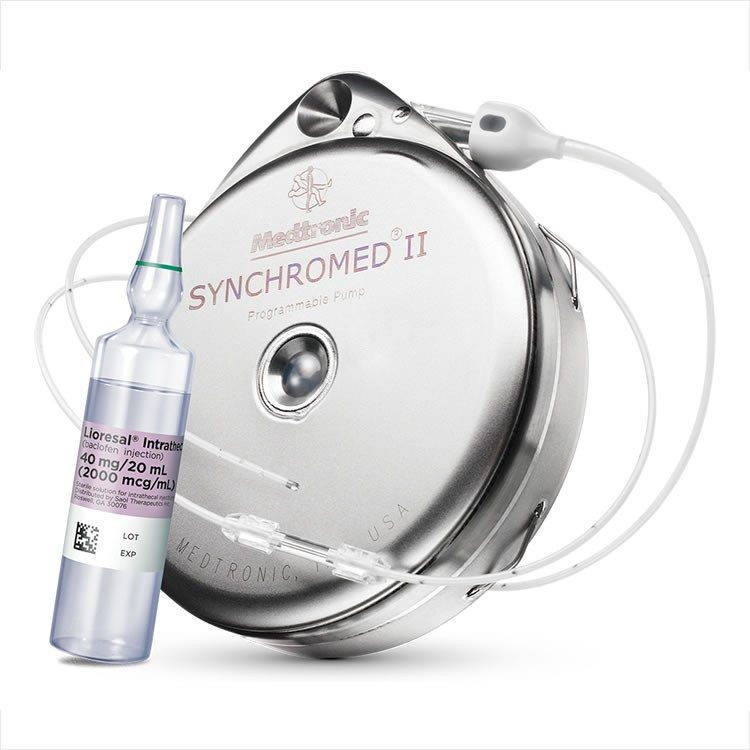
The SynchroMed™ II drug pump is a small, battery-powered device that stores and dispenses medication inside the body. The pump delivers the medicine to the fluid around the spine through a thin, flexible tube called a catheter.
A doctor programs the pump to release a certain amount of medication. Both the amount and timing can be adjusted as your needs change. For treatment of severe spasticity, the pump continuously delivers a liquid form of baclofen called Lioresal® Intrathecal (baclofen injection).
Features
- Programmed for Your Needs – Your doctor programs the device to specify how much medication should be delivered. Later, if your spasticity increases or you have a new treatment goal, your doctor can adjust the dose.
- Flex Dosing – The pump can be programmed to vary the amount of medication up to 13 different times throughout a day, so you get more or less baclofen when you need it. Programming can also vary from day to day to match your scheduled activities.
- Storage of Device Information – The pump stores important data about your device and settings, so you do not need to carry records if you travel or change clinics. A doctor accesses the information with a clinician programming device.
- Predictable Replacement – An alarm will sound before the battery runs out, so you have plenty of time to plan for replacement.
- MRI Conditionally Safe – The pump allows for full body MRI scans under specific conditions.
SynchroMed® II Drug Infusion System Brief Statement:
Product technical manuals and the appropriate drug labeling must be reviewed prior to use for detailed disclosure .
- Indications: US: Chronic intrathecal infusion of Infumorph® preservative-free morphine sulfate sterile solution in the treatment of chronic intractable pain, Prialt® chronic intrathecal infusion of preservative-free ziconotide sterile solution for the management of severe chronic pain, and chronic intrathecal infusion of Lioresal® Intrathecal (baclofen injection) for the management of severe spasticity. Outside of US: Chronic infusion of drugs or fluids tested as compatible and listed in the product labeling.
- Drug Information: Refer to appropriate drug labeling for indications, contraindications, warnings, precautions, dosage and administration, screening procedures, and under-/overdose symptoms and methods of management. Patients should be informed of the signs and symptoms of drug under- or overdose, appropriate drug warnings and precautions, and signs and symptoms that require medical attention.
- Contraindications: System implant is contraindicated in the presence of an infection; implant depth greater than 2.5 cm below skin; insufficient body size; and spinal anomalies. Use of the system with drugs with preservatives and drug formulations with pH ≤3. Use of CAP kit for refills or of refill kit for catheter access anduse of PTM to administer opioid to opioid-naïve patients or to administer ziconotide.
- Warnings: Non-indicated formulations may contain neurotoxic preservatives, antimicrobials, or antioxidants, or may be incompatible with and damage the system. Failure to comply with all product instructions, including use of drugs or fluids not indicated for use with system, or of questionable sterility or quality, or use of non-Medtronic components or inappropriate kits, can result in improper use, technical errors, increased risks to patient, tissue damage, damage to the system requiring revision or replacement, and/or change in therapy, and may result in additional surgical procedures, a return of underlying symptoms, and/or a clinically significant or fatal drug under- or overdose.
- An inflammatory mass that can result in serious neurological impairment, including paralysis, may occur at the tip of the implanted catheter. Clinicians should monitor patients carefully for any new neurological signs or symptoms, change in underlying symptoms, or need for rapid dose escalation. Monitor patients appropriately after refill if a pocket fill is suspected. Failure to recognize signs and symptoms of pocket fill and seek appropriate medical intervention can result in serious injury or death. Overinfusion may lead to underdose or overdose symptoms. Strong sources of electromagnetic interference (EMI), can negatively interact with the pump and cause heating of the implanted pump, system damage, or changes in pump operation or flow rate, that can result in patient injury from tissue heating, additional surgical procedures, a return of underlying symptoms, and/or a clinically significant or fatal drug underdose or overdose. The SynchroMed II system is MR Conditional; consult the labeling for MRI information.
- Precautions: Monitor patients after pump or catheter replacement for signs of underdose/overdose. Infuse preservative-free saline at minimum flow rate if therapy is discontinued for an extended period of time to avoid system damage. EMI may interfere with programmer telemetry during pump programming sessions. EMI from the SynchroMed programmer may interfere with other active implanted devices (e.g., pacemaker, defibrillator, neurostimulator).
- Adverse Events: In addition to procedure-related risks, the following may occur: pocket seroma; hematoma; erosion; infection; pump inversion; post-lumbar puncture risks (spinal headache); CSF leak and rare central nervous system pressure-related problems; radiculitis; arachnoiditis; spinal cord bleeding/damage; meningitis; neurological impairment (including paralysis) due to inflammatory mass; allergic response to implant materials; surgical replacement due to end of service life or component failure; loss of therapy, drug overdose, or inability to program the pump due to component failure; catheter complications resulting in tissue damage or loss of or change in therapy; potential serious adverse effects from catheter fragments in intrathecal space.